


-
0:00/6:24
-
0:00/7:55
ROBERTO MAGRIS MEXICAN TRIO

ROBERTO MAGRIS - PIANO
ROBERTO AYMES - BASS
LUIS MARTINEZ - DRUMS
In 2024, Roberto Magris began a fruitful collaboration with Mexican double bassist Roberto Aymes, first performing a series of concerts in Mexico City as a duo, and then, in 2025, as a trio with the addition of Mexican drummer Luis Martinez. This trio performed additional concerts in Mexico City and recorded the live CD “Roberto Magris Trio Live in Mexico City” . In 2026, the trio reunited once again for concerts in Mexico City and to record a new studio CD titled “Hawesome!”, which revisits the songbook of Hampton Hawes, a legendary post-bop pianist who is largely forgotten today. The trio has received widespread acclaim from international critics, with reviews appearing in major international jazz magazines and websites.
New Cd released on September 1, 2026
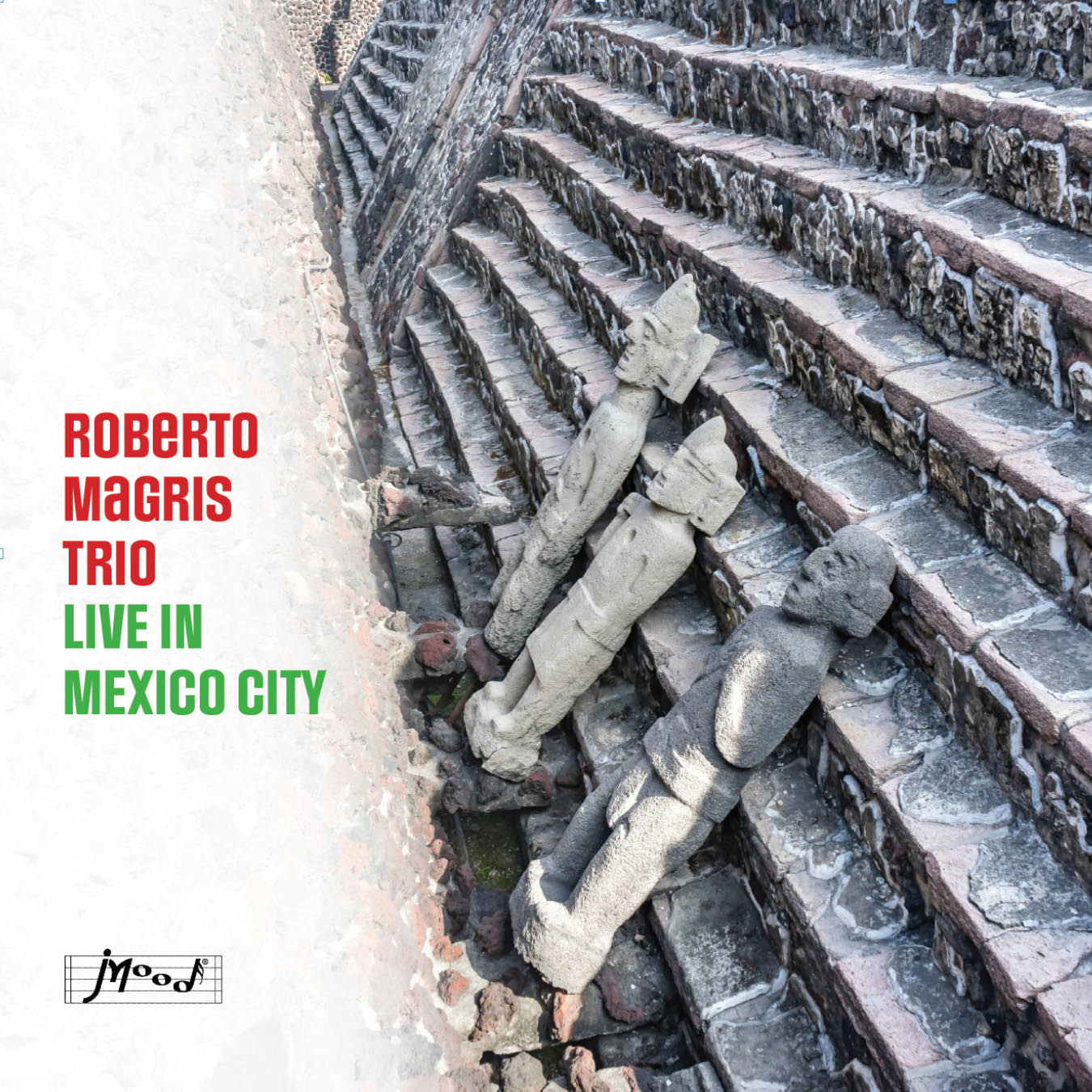
Live in Mexico City
Swing is the watchword of this stellar live outing by Roberto Magris, the Italian pianist-composer’s 34th recording as a leader or co-leader for the Kansas City-based JMood Records. Recorded at Julián Carrillo Hall in Mexico City, it showcases Magris’ penchant for old school swing juxtaposed with bold exploration, this time in the company of two notable Mexican musicians in bassist Robert Aymes, an iconic figure in his country since the ‘70s, and rising star drummer Luis Martinez. Together these three kindred spirits strike a rare accord on four familiar standards (Tadd Dameron’s “If You Could See Me Now,” Ned Young’s “Stella By Starlight,” Guy Wood’s “My One and Only Love” and Jerome Kern’s “In Love in Vain”) along with two blues-tinged Magris originals (“Another More Blues,” “Iraqi Blues”), his stirring modal number (“Song for an African Child”) and a medley of tunes from two personal piano heroes (McCoy Tyner’s “For Tomorrow” and Don Pullen’s “Joyce Girl”).
How Magris, born in the northern Italian port city of Trieste, where he still lives to this day, came to collaborate with two musicians he had never met before at a venue over 6,000 miles away is a story of serendipity that really paid off in spades. As he explained, “My collaboration with double bassist Roberto Aymes began in 2024 during my first visit to Mexico City after many years away. My son Martin had signed a contract to teach at ITAM University in Mexico City, so in the fall of that year I traveled there to visit him. In the meantime, I had told my friend (Czech double bassist) Frantisek Uhlir that I was planning a trip to Mexico and he suggested, ‘Why don’t you try contacting my friend Roberto? It might be a good opportunity to play together in some concerts there.’ No sooner said than done. And I hit it off with Roberto right away, both musically and personally.”
Their first concerts, sponsored by the Italian Cultural Institute in Mexico City, came in 2024. When Magris returned to Mexico City in 2025, he performed a series of concerts in a trio with Roberto and drummer Luis Martinez. One of those concerts took place at Radio UNAM, an important station owned by the Universidad Nacional Autónoma de México with a program dedicated to jazz, “Panorama del Jazz,” that has been on the air continuously since 1954 and has been hosted since 1978 by bassist-composer-producer-educator Aymes. “Roberto is a true icon of Mexican jazz with a career spanning over 50 years,” said Magris. “He has made a fundamental contribution to the spread and development of jazz in Mexico, while also maintaining an international jazz career. Luis Martinez, on the other hand, is one of the leading drummers on the current Mexican jazz scene and has been collaborating with Roberto for many years.”
That would explain the indelible chemistry we hear from the interactive rhythm tandem, whether swinging forcefully on “Stella” and “In Love in Vain” or creating a delicate undercurrent on gorgeous ballads like “If You Could See Me Now” and “My One and Only Love.”
The session opens with the conjoining of two beguiling themes in Tyner’s “For Tomorrow” (from 1977’s Inner Voices) and Pullen’s “Joycie Girl” (from 1975’s Capricorn Rising), both based on a two-chord vamp. Said Magris, “I like to start my concerts with a short piano solo or an introduction to help set a certain initial atmosphere on which to build the concert. In this case, the C and D vamp on the McCoy tune sets the stage for the beginning of the Pullen tune, with a vamp raised by one tone. Tyner filled his phrasing with chords that did not derive from a harmonic progression but from the development of modal scales, and thus essentially improvised only over a single key or two chords, which he also did so brilliantly on John Coltrane’s version of ‘My Favorite Things.’ Consequently, Coltrane’s music and Tyner’s piano playing led me to appreciate the performance and improvisation of sequences consisting of just one or two chords, which offer great rhythmic and timbral freedom, distinct from that of pieces based on harmonic progressions such as standards and bebop. As for ‘Joycie Girl,’ it’s my own reworking of the riff that appears on that tune from the Don Pullen/Sam Rivers duet album Capricorn Rising, which is one that I’ve often included in my trio concert program as a way to remind the audience of Don Pullen, a pianist who was forgotten too soon and remembered too superficially.”
Magris’ cascading piano lines sail over this mesmerizing two-chord vamp while Martinez plays interactively and melodically on the kit and Aymes introduces his bold, authoritative bass, reminiscent in tone and drive to Eddie Gomez. “Roberto is a highly skilled and talented musician, a fact I recognized immediately the first time we played together,” said Magris. “He is above all a jazz double bassist inspired by the great masters of the tradition (his favorites are Eddie Gomez, Ray Brown, and Rufus Reid). And as a natural result, he has a swing feel that is both powerful and fluid, which makes it a real pleasure for me to play along with. Stylistically, it makes me feel ‘at home.’ As for his characteristic sound, it stems from the unique handmade instrument he plays—a cross between a double bass and a viola da gamba—which he designed himself and had built in the U.S. by luthier Jack Pimentel.”
The mid-tempo minor key “Another More Blues” is a showcase for Aymes’ formidable walking bass lines and Martinez’s hip, swinging statements on drums. Magris takes some liberties on this cool blues number, drifting outside the harmony a bit on his intrepid solo in a manner reminiscent of the aforementioned Pullen. Aymes’ bass solo here is similarly brimming with daring and verve.
The driving modal number “Song for an African Child” allows for more stretching and deconstruction by the pianist while the gentle brushes ballad “If You Could See Me Now” is strictly in the tradition, underscored by the rhythm tandem’s elegant, highly interactive chemistry. Aymes’ bass solo here is melodic and virtuosic while Magris unleashes some whirlwind chops on his solo here, at one point dropping in a touch of the Errol Garner-Red Garland ‘locked hands’ approach along the way. “Of course, it’s impossible for me not to know and appreciate Erroll Garner and Red Garland, with their style based on a distinctive use of chords,” said Magris, “but in general, when I tackle pieces from the bop era — and in this case, it’s a classic Tadd Dameron tune — I automatically find myself entering that world of piano inspired by Bud Powell and Monk and then perfected by fantastic musicians like Hank Jones, Elmo Hope, Horace Silver, Sonny Clark and Barry Harris. And, personally, I have never underestimated the harmonic aspect of bop piano — with its distinctive features, including block chords — which is often mistakenly overshadowed by the right-hand phrasing, especially in ballads.”
An uptempo “Stella” comes swinging hard right out of the gate, paced by Aymes’ forceful walking bass lines and Martinez’s syncopated sizzle on the ride cymbal. Magris takes more harmonic liberties here while never losing the intense swing feel. And his rapid-fire, freewheeling exchanges with bassist Aymes midway through are positively Monkish.
A gorgeous solo piano intro segues to a reverential rendition of “My One And Only Love,” underscored by Martinez’s gentle brushwork. As the piece gradually opens up, Magris begins raining down single note lines and expressive asides in an attempt at making the piece his own. As he explained, “After having played my most cherished songs hundreds of times, an almost Zen-like bond has formed between me and some of them, including ‘My One and Only Love,’ which has always been one of my favorite ballads. I’ve modified some chords and harmonic passages here, personalizing them from the original and thus making this song even more my own. On these songs that I’ve been playing my whole life, I improvise freely, trying to rediscover new and different emotional aspects and melodic passages each time, thanks to the intrinsic beauty of both their music and lyrics.”
Magris’ syncopated and decidedly funky “Iraqi Blues” stands apart, stylistically, from the rest of the tunes on Live in Mexico City. As he explained, “This song has a story behind it. In 2006, I was supposed to record an album in Kansas City with the legendary Jay McShann, thanks to the fact that Paul Collins had been a long-time family friend. Unfortunately, just when everything had been decided and was ready to go, McShann, who was already quite advanced in years, passed away. So, when I arrived in Kansas City, I met with his grandson Jason, partly in the hope that McShann might have kept an archive of his compositions and arrangements that I could eventually use (but unfortunately, that wasn’t the case). To my great surprise, however, Jason spoke to me about his shocking experience in Iraq as a soldier and the cruelty and futility of war. So, at the end of our meeting, I left partly disappointed but also equally shocked by what I had been told. At the time, I was working on a new composition of my own, a sort of unconventional blues piece that featured chords that had an Eastern-inspired theme that, at times, might have reminded one of a passage from Tizol’s classic ‘Caravan.’ The rhythm was a bit funky, a sort of old-school groove. I hadn’t yet thought of a title for this piece, nor had I ever played it in concert. But after my meeting with Jason, it became inevitable that I would title it ‘Iraqi Blues.’ Roberto and Luis beautifully entered the oriental but funky atmosphere of this kind of blues.”
Aymes’ bass solo here is potent and funky, marked by a bit of old school slapping on his instrument, while Martinez solos melodically, creatively filling the cracks of on this blues form. And catch the brief, fleeting quote from “Caravan” that Magris drops in midway through the piece.
They close in old school swinging fashion with a fresh take on “In Love in Vain,” paced by Martinez’s spang-a-lang on the ride cymbal and Aymes’ unerring bass pulse. Magris’ piano solo is effervescent and unfettered here, diving into some playful Pullen-isms and Cecil-isms (as in Taylor) along the way. “I’ve always found it interesting to incorporate a free-form approach into my improvisation, using altered phrasing in a free and dissonant style over a steady rhythmic pulse and within the regular progression of the harmonic structure,” he said. “It’s certainly a risk, a challenge, even for the audience, who might wonder, ‘What on earth is he playing now?’ It’s somewhat similar to what happened with Don Pullen ‘breaking out’ in his solos while remaining within Mingus’s world, and with Cecil Taylor and his unique free approach to the keys. And there’s also the aspect of the contrasting rhythmic movement in the phrasing between the right and left hands. I believe I heard this ‘asymmetrical interlocking’ style already in classic bop played by Joe Albany, for example, who is another forgotten, if not sadly unknown, truly original jazz pianist. So, alongside Pullen and Taylor, I would also add Joe Albany as a possible reference to my ‘zone of interest’ here.”
The spirited exchanges between Aymes and Martinez on “In Love In Vain” put an exclamation point on this spirited set-closer. Chalk up another one triumph for Magris. He sure got a lot of mileage (literally) out of his trip to Mexico City. — Bill Milkowski